A beautiful scent can disappear by lunch or become overwhelming before you leave home. The difference often comes down to order, dosage, and note balance. When readers ask me how to layer perfume oil and body spray, I recommend building depth close to the skin before adding a lighter scent halo.
Perfume oil usually creates an intimate base, while body spray provides broader diffusion. Applying oil first gives each product a clear purpose. However, no application method guarantees a fixed wear time. A 2025 cosmetic-science study found that fragrance evaporation can vary according to both the fragrance molecules and the wearer’s skin properties.
Why Perfume Oil Goes Before Body Spray

The most practical order is moisturizer, perfume oil, and body spray. Lotion prepares the skin. Perfume oil establishes the deeper scent. Body spray adds brightness, freshness, and projection.
This order also makes the strength easier to control. If the oil already smells powerful, I reduce the body spray. If the base feels too quiet, I add one more mist.
Do not assume every oil is stronger than every body spray. Concentration, ingredients, carriers, and application amounts differ between products. Follow the directions on each label.
The International Fragrance Association maintains standards that may limit, restrict, or prohibit certain fragrance materials when safety concerns arise. Manufacturers still carry responsibility for ensuring their finished products are safe and properly formulated.
How To Layer Perfume Oil And Body Spray Step by Step
Start With Clean, Moisturized Skin
Apply your fragrances after showering, when your skin is clean and slightly damp. Use fragrance-free lotion when you want both scents to remain easy to identify.
Following the principles of What Does Clean Beauty Mean in Body Care? also supports healthier skincare by encouraging the use of gentle, skin-friendly, and minimally irritating body care products that allow fragrances to perform well without unnecessary additives interfering with the scent or skin comfort.
A matching scented lotion can work, but it adds another set of notes. Choose one only when it complements both fragrances.
Moisturizer does not trap perfume for a guaranteed number of hours. It simply creates a smoother base and can make fragrance feel less fleeting on dry skin. Let the lotion settle for about a minute before applying oil.
Place Perfume Oil on Warm Areas

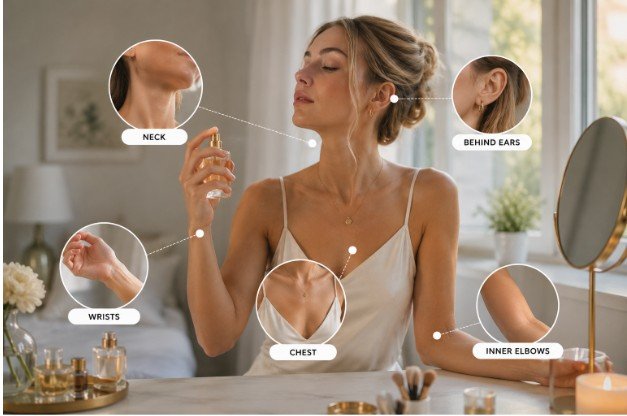
Apply small amounts to your wrists, inner elbows, upper chest, or the sides of your neck. Two or three locations are usually enough.
I avoid covering every pulse point. Too many placements can make a concentrated oil feel heavy before the body spray is added.
For a subtle workday scent, place the oil on your upper chest beneath clothing. For stronger evening projection, use the neck and inner elbows.
Avoid applying fragrance to broken, irritated, sunburned, or freshly shaved skin. Fragrance products can cause irritation or allergic contact dermatitis in sensitive users.
Add Body Spray as the Lighter Layer
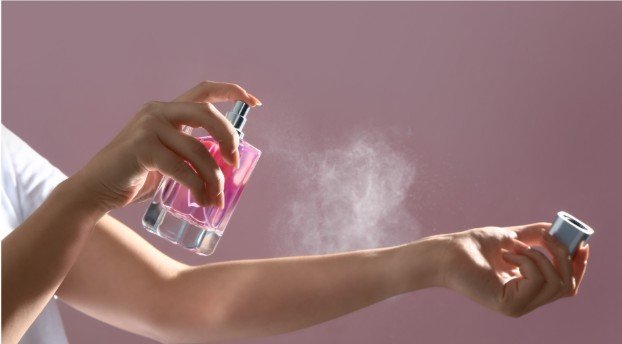
Hold the bottle several inches from your body. Apply one or two mists near the areas where you placed the oil.
The body spray does not need to soak the exact same spot. Spraying nearby allows the lighter fragrance to expand while the oil remains closer to the skin.
When practicing how to layer perfume oil and body spray, resist the urge to stand inside a large fragrance cloud. Body spray may smell lighter than perfume, but repeated spraying can still become overpowering.
Wait until the liquid carrier evaporates before judging the strength. The opening may smell sharper or more alcoholic than the settled fragrance.
You can mist clothing for added wear, but test a hidden section first. Colored liquids and oils may mark delicate or pale fabrics. Avoid spraying regular body mist directly through your hair unless the label permits that use. A dedicated hair mist is usually the safer format.
Wait for the Dry-Down
Check the pairing after 15 minutes and again after one hour. The first spray emphasizes brighter top notes, which can make the initial combination misleading.
A blend that smells balanced during the first minute may later become too sweet, smoky, powdery, or musky. The one-hour check reveals how the scents behave after their opening fades.
This waiting period is one of the most useful parts of learning how to layer perfume oil and body spray. It stops you from adding more fragrance before the existing layers have settled.
Use the 3-2-1 Scent Calibration Method
My original 3-2-1 method makes fragrance layering easier to repeat:
- Apply three tiny touches of perfume oil.
- Add two light body-spray mists.
- Perform one dry-down check after an hour.
Change only one amount during your next wear. Reduce the oil if the combination feels dense. Add one body-spray mist if the scent lacks brightness or projection.
This approach turns how to layer perfume oil and body spray into a controlled experiment rather than a guessing game.
Fragrance Layering Combinations That Smell Intentional

Match Scent Families for an Easy Blend
Similar fragrance families create the simplest combinations. Vanilla oil works with coconut, caramel, amber, brown sugar, or soft musk spray.
Rose oil pairs naturally with peony, lychee, sandalwood, or clean musk. Citrus oil can brighten green tea, neroli, aquatic, or light floral body sprays.
The products do not need identical notes. One shared note can act as a bridge and keep the combination cohesive.
Create Contrast for a Signature Scent
Contrast adds dimension when one product is deep, and the other is bright. Consider sandalwood oil with grapefruit spray, amber oil with orange blossom mist, or vanilla oil with cherry body spray.
For a worked example, place warm vanilla oil on the upper chest and inner elbows. Add one tart cherry mist near the neck and another on a shirt.
The vanilla softens the sharp fruit note. The cherry prevents the warm base from becoming overly dessert-like. This controlled contrast creates a more distinctive result than simply doubling the same vanilla profile.
Balance Sweet Scents With Dry Notes
When a fragrance pairing smells too sugary, introduce musk, cedar, tea, salt, vetiver, or gentle spice.
A marshmallow oil paired with another candy-style mist may become dense. A woody or tea-based spray gives the sweetness structure without removing it.
The same principle works in reverse. A dry sandalwood or vetiver oil can feel softer when topped with pear, vanilla, peach, or a creamy floral mist.
Common Fragrance Layering Mistakes
The biggest mistake is applying too much before the dry-down. Another is combining several dominant notes without a shared note connecting them.
Avoid spraying your skin, clothes, and hair heavily during the first application. You will struggle to identify which product caused the imbalance.
Do not treat a natural perfume oil as automatically safer than a synthetic fragrance. Safety depends on the material, concentration, exposure, and formulation—not simply whether an ingredient came from a plant. IFRA explains that natural does not automatically mean safer.
The FDA also notes that fragrance formulas may cause allergic reactions or sensitivities in some people, even when those products are safe for most users.
Anyone with eczema, a known fragrance allergy, or reactive skin should use extra caution. The American Academy of Dermatology recommends applying a new cosmetic to a small test area twice daily for seven to ten days. Stop using it if redness, itching, or swelling develops.
Remember that “unscented” does not always mean fragrance-free. Manufacturers may use fragrance ingredients to mask the natural odors of other ingredients.
How To Make a Layered Fragrance Last Longer
Understanding how to layer perfume oil and body spray is only one part of fragrance longevity. Storage, dosage, skin condition, and reapplication also affect the experience.
Keep your bottles away from direct sunlight, humid bathroom shelves, and hot cars. Close every cap securely. Store rollerball perfume upright when the packaging recommends it.
Avoid rolling perfume oil directly over wet lotion. Lotion residue can collect around the rollerball and contaminate the applicator. Allow your moisturizer to absorb first.
For a long workday, carry the body spray instead of repeatedly adding perfume oil. A light mist can refresh the brighter notes without making the base increasingly dense.
Apply the refresher in a restroom or another private space. Spraying fragrance at a desk, restaurant table, airplane seat, or on public transit can affect people with allergies or fragrance sensitivities.
The most powerful routine is not always the most polished one. Your scent should feel noticeable within your personal space, not announce your arrival from across the room.
Frequently Asked Questions
1. Can I mix perfume oil and body spray in one bottle?
No. Their different carriers may separate or affect stability, so apply the finished products separately.
2. How long should I wait between perfume oil and body spray?
Wait about one minute, or until the perfume oil no longer feels noticeably wet.
3. How do I layer different fragrance families?
Connect contrasting families through one shared note, such as vanilla, musk, citrus, amber, or wood.
4. Can I use this perfume layering method for work?
Yes. Use oil beneath clothing and limit the body spray to one light mist for softer projection.
Your Scent, Your Rules—Just Keep It Chic
Once I understand how to layer perfume oil and body spray, I stop chasing maximum strength and start creating balance. Perfume oil provides depth. Body spray controls freshness and reach. A measured application keeps both products recognizable.
The dry-down matters more than the first ten seconds. Give every pairing time to settle before deciding it needs another spray.
Use the 3-2-1 method tomorrow: three tiny oil touches, two light mists, and one honest review after an hour. That is how to layer perfume oil and body spray without turning your signature scent into a scented fog.