Humidity can make skin feel damp while it is still losing water. That apparent contradiction explains why abandoning moisturizer during a muggy summer often backfires. Sweat, frequent showers, swimming, sun exposure, and hours spent in air-conditioned rooms can all affect the skin barrier. The American Academy of Dermatology also recommends moisturizer even for acne-prone skin when dryness develops.
The real question is therefore not whether to moisturize. Learning how to choose a body moisturizer for humid weather means finding enough hydration to support the skin barrier without leaving behind the thick, greasy film that becomes uncomfortable once temperatures climb.
Why Humidity Changes What Your Skin Needs
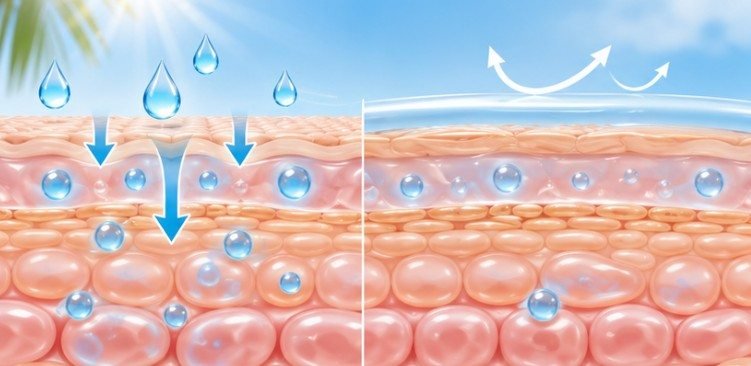
The outermost layer of skin, the stratum corneum, works partly as a water-control system. Water continually moves outward through the skin in a process known as transepidermal water loss, or TEWL.
Research reviewed by the National Library of Medicine shows that moisturizers can increase skin hydration, support the lipid barrier, and reduce excessive TEWL.
Humidity can slow evaporation and allow certain moisture-binding ingredients to work effectively. But it does not eliminate every cause of dehydration.
Consider a typical August day in Miami, Houston, or Charleston. You may sweat outdoors, shower afterward, sit under strong office air conditioning for eight hours, then shower again after exercising. Your skin experiences dramatically different environments within one day.
That is why the moisturizer that feels perfect in January may feel unbearable in July.
The Three Moisturizer Components Worth Understanding
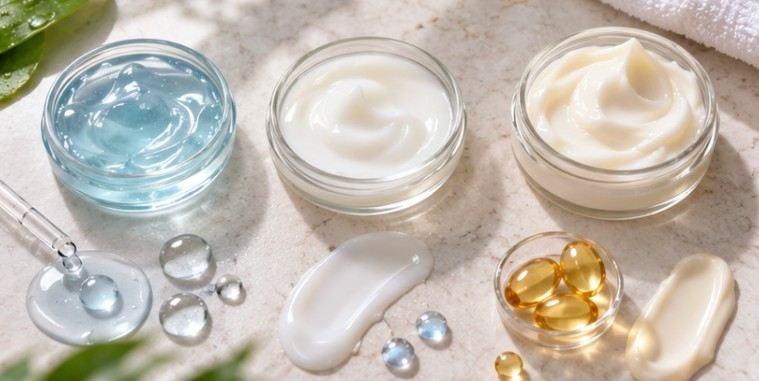
You do not have to become a cosmetic chemist to shop intelligently. Most useful moisturizers contain some combination of humectants, emollients, and occlusives.
Harvard Health describes humectants as ingredients that attract water, occlusives as ingredients that slow water evaporation, and emollients as substances that smooth rough areas of the skin.
Humectants: Usually Your Best Starting Point
For humid conditions, look first for ingredients such as:
- glycerin
- hyaluronic acid
- panthenol
- urea
- sodium PCA
Glycerin is particularly practical because it binds water without requiring the heavy oily texture associated with richer body creams.
Hyaluronic acid primarily hydrates closer to the skin’s surface because its larger molecules do not penetrate as deeply as smaller humectants such as glycerin or urea.
Emollients: Useful for Roughness and Barrier Support
Emollients fill tiny spaces between surface skin cells, improving softness and flexibility. Ceramides deserve particular attention because naturally occurring ceramides form part of the skin’s lipid barrier. A lightweight lotion containing ceramides can therefore provide barrier support without automatically creating the waxy feeling associated with body butter.
Occlusives: Helpful, but Texture Matters
Petrolatum, mineral oil, lanolin, silicones, and certain waxes reduce evaporation by creating a protective layer.
Occlusion is extremely useful for cracked heels, eczema-prone patches, elbows, and severely dry skin. But applying a very rich petrolatum-heavy cream over the entire body before stepping into 90-degree humidity may feel unnecessarily uncomfortable.
DermNet notes that ointments are generally more occlusive than creams and lotions.
The Humidity Test: Match Texture to Your Skin
Use this simple decision process when choosing your next bottle.
| Your skin in humid weather | Better starting texture | Ingredients to prioritize |
| Normal but occasionally tight | Fluid lotion | Glycerin, ceramides |
| Oily or breakout-prone | Gel or lightweight lotion | Glycerin, hyaluronic acid |
| Dry despite humidity | Light cream | Ceramides, glycerin, dimethicone |
| Very dry or eczema-prone | Cream plus targeted ointment | Ceramides, petrolatum |
| Sensitive or easily irritated | Fragrance-free lotion | Glycerin, ceramides, simple formula |
The important word here is starting. Climate matters, but your own skin response matters more.
If a gel leaves your legs tight two hours later, move one level richer. If a cream remains slippery long after application, move one level lighter.
Check These Four Things Before Buying
Knowing how to choose a body moisturizer for humid weather becomes easier when you ignore front-label marketing and evaluate four practical characteristics.
1. Look at the Texture Before the Claims
Terms such as “deep hydration” and “72-hour moisture” do not tell you how a product will feel during a humid afternoon.
Gel-creams, milky lotions, and fluid emulsions generally spread faster and leave less residue than body butters and ointments.
2. Look for Non-Comedogenic Options if You Break Out
Heat, friction, sweat, and occlusion can contribute to summer body breakouts.
The American Academy of Dermatology advises acne-prone people to look for labels such as “non-comedogenic,” “oil-free,” or “won’t clog pores.” It also recommends changing out of sweaty clothing and using gentle skin care rather than aggressive scrubbing.
This is particularly useful if you develop bumps on your back, shoulders, or chest.
3. Do Not Automatically Fear Every Oil
“Oil-free” can be useful for acne-prone skin, but it is not a universal requirement.
Some lightweight formulations use small amounts of emollient oils without feeling greasy. Silicones such as dimethicone can also provide useful moisture retention without the heaviness of a traditional body butter.
Judge the total formulation, not one ingredient.
4. Choose Fragrance-Free if Heat Makes You Sensitive
Sweat, heat, shaving, and clothing friction can make already-sensitive skin feel more reactive.
Fragrance is also a well-recognized cause of allergic contact dermatitis. Research indexed by the National Library of Medicine found fragrance was the most common potential allergen among 276 moisturizers examined in one study.
If your skin frequently burns, itches, or develops unexplained patches, choosing fragrance-free rather than merely “unscented” is a sensible starting point.
Apply Less Product at a Better Time
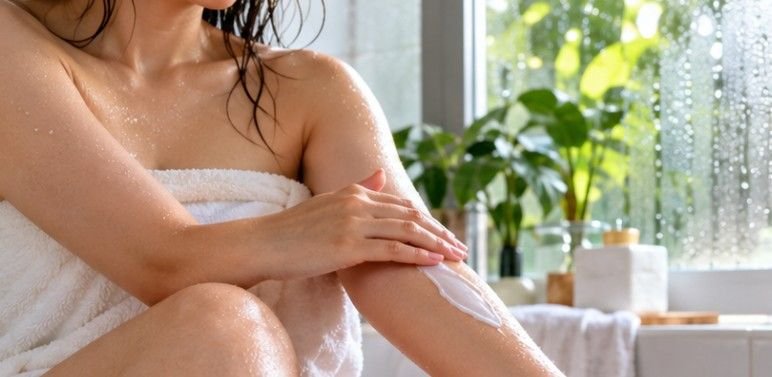
More moisturizer does not necessarily mean better hydration. After showering, gently pat your body so the skin remains slightly damp. Apply a thin layer of moisturizer immediately afterward.
Occlusive ingredients are particularly effective when used on damp skin because they help slow the evaporation of that remaining water. Research reviews on moisturizers consistently support post-bathing application.
Start with roughly enough lotion to create a thin, comfortable film. If your skin remains sticky 10 or 15 minutes later, you probably applied too much or need a lighter formula.
During especially humid weeks, you may also moisturize selectively. Apply lotion everywhere that feels dry while using richer cream only on elbows, knees, hands, or lower legs.
What About Body Mists and Hydrating Sprays?
Hydrating body sprays can feel excellent in hot weather because they deliver water and humectants with little residue. Their limitation is staying power.
A spray containing mostly water and humectants may not prevent evaporation as effectively as a well-formulated lotion containing a small amount of emollient or occlusive material. Treat sprays as an option for mildly dry skin rather than an automatic substitute for moisturizer.
Moisturizer Can Also Affect How You Wear Fragrance
Moisturized skin can change the way fragrance sits and develops. If fragrance is part of your routine, see this guide to making layered fragrance last longer before piling multiple scented products onto freshly moisturized skin.
People whose skin reacts easily to perfume may instead prefer a fragrance-free moisturizer underneath scent. The site’s perfume layering routine for sensitive skin explains a gentler approach.
When the Lightweight Rule Does Not Apply
Humid weather does not automatically mean everyone needs a gel.
Someone with eczema, chronically dry skin, ichthyosis, an impaired skin barrier, or irritation from medication may still require a substantial cream or ointment. The National Library of Medicine’s clinical review emphasizes that moisturizers are designed to increase skin water content and help restore barrier function.
Persistent cracking, bleeding, severe itching, painful dryness, or a spreading rash deserves evaluation by a dermatologist rather than endless moisturizer experimentation.
Frequently Asked Questions
1. Should I moisturize my body every day in humid weather?
Yes, if your skin feels dry or tight. Choose a lighter lotion or gel and adjust the amount rather than automatically skipping moisturizer.
2. Is gel moisturizer better than lotion in humidity?
Gel feels lighter, but it is not universally better. Normal or oily skin may prefer gels, while dry or eczema-prone skin often needs a lotion or cream.
3. Which ingredients are best in a summer body moisturizer?
Glycerin, hyaluronic acid, ceramides, panthenol, and lightweight emollients are useful starting points. Acne-prone skin may also benefit from non-comedogenic formulas.
4. How do I know if my moisturizer is too heavy?
Persistent greasiness, excessive stickiness, increased clogged pores, or discomfort under clothing can indicate that you need less product or a lighter formulation.
The Takeaway
Humidity changes how moisturizer feels far more than it changes your skin’s fundamental need for a functioning barrier. Instead of abandoning hydration as soon as summer arrives, adjust the texture.
The best approach to how to choose a body moisturizer for humid weather is surprisingly simple: start with a light, humectant-rich lotion, look for barrier-supporting ingredients such as ceramides, apply it to slightly damp skin, and watch how your skin responds.
If you remain sticky, go lighter. If you become tight or flaky, go richer. Your skin—not the weather forecast—should make the final decision.