Walk into any cosmetics retailer and you face an ocean of pastel bottles, eucalyptus leaves, and promises of botanical purity. I spent years buying products labeled “non-toxic” and “pure,” assuming these words had legal backing. They do not. Learning how to identify greenwashing in clean beauty brands revealed that marketing departments frequently use unregulated eco-jargon to charge premium prices for conventional, petroleum-derived formulas.
Federal agencies do not legally define terms like “clean,” “pure,” or “earth-friendly.” The U.S. Food and Drug Administration (FDA) regulates cosmetic labeling primarily for safety, misbranding, and ingredient declaration order—not for subjective sustainability words. When you master a systematic label-audit framework, you stop paying for marketing narratives and start buying genuine product integrity.
Unmasking the Clean Beauty Shell Game
Greenwashing occurs when a company spends more resources projecting an environmentally friendly image than reducing its actual ecological impact. In personal care, this practice exploits conscious consumer trends.
The Federal Trade Commission (FTC) Green Guides require companies to substantiate all environmental marketing claims with reliable evidence. Even so, cosmetic brands exploit gray areas.
They highlight one cold-pressed oil while suspending it in synthetic thickeners and unrecyclable composite packaging. To cut through the theater, you must separate packaging aesthetics from chemical realities.
Step 1: Decode Front-Label Distractions and Visual Traps
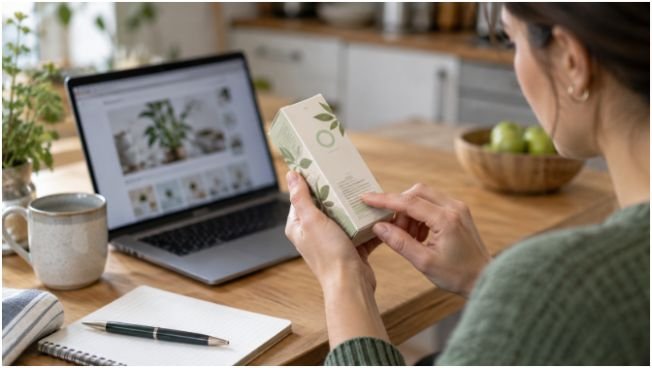
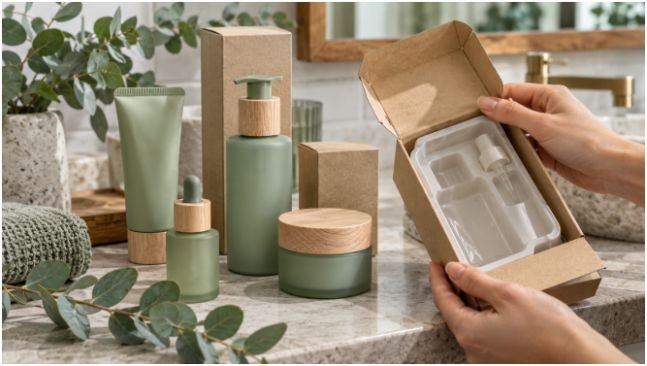
Front packaging sells an emotional story. Brands deliberately select matte kraft textures, muted earth tones, and faux-wood caps to trigger psychological associations with nature.
I ignore the artwork entirely and scrutinize the copy for specific misdirection tactics.
[ FRONT LABEL THEATER ]
“Wild-Harvested Rose & Botanical Youth Elixir”
│
▼
[ REALITY CHECK ]
Look past the leaf graphics, matte earth tones, and decorative caps.
These visual cues carry zero regulatory accountability.
Spotting Irrelevant “Free-From” Claims
Brands love advertising what is missing instead of what is present. You will routinely see “sulfate-free” emblazoned across an oil-based face serum. Sulfates are cleansing surfactants used in foaming washes and shampoos; they have no function in an oil serum.
Highlighting their absence creates an artificial health halo while distracting you from cheap filler bases. Look out for “paraben-free” claims that mask the addition of irritating synthetic fragrance compounds or unlisted chemical stabilizers.
The Myth of “Chemical-Free” Formulas
Any beauty brand claiming to be “chemical-free” is presenting a scientific impossibility. Water is a chemical (H2O). Cold-pressed rosehip seed oil contains complex chemical compounds, including fatty acids and carotenoids.
Brands relying on “chemical-free” slogans are banking on scientific illiteracy. When a company uses fear-based marketing instead of transparent ingredient explanations, put the bottle down.
Step 2: Master the INCI List and the 1% Rule
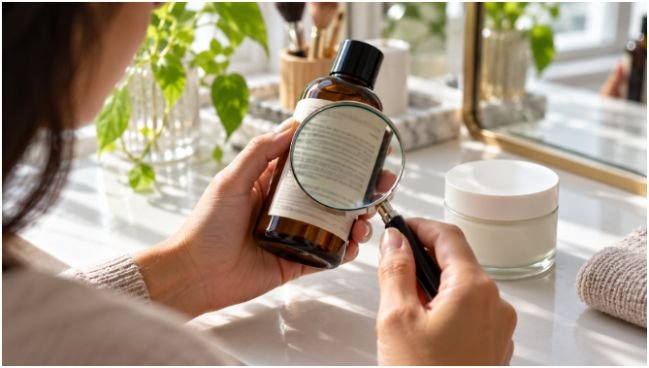
The International Nomenclature of Cosmetic Ingredients (INCI) panel on the back or bottom of the container reveals the true formulation. Regulations require cosmetic manufacturers to list ingredients in descending order of predominance by weight down to the 1% concentration threshold.
Below 1%, manufacturers can list ingredients in any order they choose.
TYPICAL GREENWASHED SERUM FORMULATION:
┌────────────────────────────────────────────────────────┐
│ Aqua (Water) │ Top Ingredients
│ Glycerin │ (Bulk of Formula,
│ Dimethicone (Silicone) │ 90–95% total weight)
│ Butylene Glycol │
├────────────────────────────────────────────────────────┤
│ Phenoxyethanol (Max legal limit: 1.0%) ─── [ 1% LINE ] │
├────────────────────────────────────────────────────────┤
│ Rosa Damascena Flower Extract (0.05%) │ “Hero” Botanicals
│ Argania Spinosa Kernel Oil (0.01%) │ (Fairy-dusted for
│ CI 19140, Parfum (Synthetic Fragrance) │ marketing claims)
└────────────────────────────────────────────────────────┘
Finding the Phenoxyethanol Benchmark
I always search for preservatives first to find the “1% line.” In the United States and the European Union, the broad-spectrum preservative phenoxyethanol is legally capped at a maximum concentration of 1% in finished cosmetic products. Other common 1% marker compounds include xanthan gum, carbomer, and ethylhexylglycerin.
Once you locate phenoxyethanol on an INCI deck, every ingredient printed after it exists at 1% or less. If a brand advertises a “Nourishing Camellia Oil Moisturizer,” but Camellia Sinensis Seed Oil appears five spots below phenoxyethanol, that botanical is present in a microscopic amount.
Formulators refer to this as “fairy dusting”—adding a fraction of a percent simply to print the ingredient on the front label.
Unmasking Blanket Fragrance Loopholes
Under trade-secret protections, cosmetic regulations allow brands to list “Fragrance” or “Parfum” as a catch-all term. A single line item for fragrance can conceal dozens of unlisted synthetic components, including diethyl phthalate (DEP), a plasticizer linked to endocrine disruption.
Authentic sustainable brands eliminate proprietary secrecy. They clearly state “100% naturally derived fragrance,” explicitly itemize their essential oil isolates, or verify their safety profile through the EWG Skin Deep® Database.
Step 3: Verify Independent Third-Party Certifications
When a brand invents an in-house badge—like a green circle declaring “Planet Pure Approved”—it costs them nothing and proves less. Trustworthy validation requires third-party testing organizations with published, auditable criteria.
| Certification Mark | Auditing Body | Standard Enforced |
| COSMOS Organic | COSMOS-Standard AISBL | At least 95% physically processed agro-ingredients from organic farming; zero petrochemical derivatives. |
| Leaping Bunny | Coalition for Consumer Information on Animal Cosmetics (CCIC) | Verifiable animal testing cutoff date that audits raw ingredient suppliers, not just the finished formula. |
| EWG Verified® | Environmental Working Group | Full disclosure of all ingredients, zero prohibited chemical list matches, strict manufacturing controls. |
| Certified B Corp | B Lab | Legally binding environmental performance, fair worker compensation, and supply chain accountability. |
If a bottle displays an unfamiliar eco-symbol, search the certifying registry online before purchasing. Legitimate organizations maintain searchable directories of certified brands.
Step 4: Audit Brand Operations Beyond the Bottle
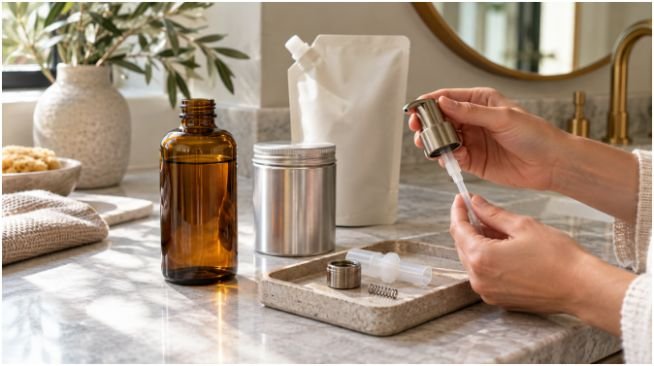
A non-toxic serum packaged in single-use acrylic containers with zero supply chain accountability is not sustainable. You must evaluate the operational footprint behind the product.
First, check the raw material sourcing. Plant-based ingredients can drive severe environmental damage when harvested recklessly. Look for certified sustainable palm oil derivatives (RSPO) and ethically sourced mica mined without child labor.
Next, inspect packaging claims with a critical eye. Vague stamps like “Recyclable” often mean the material is theoretically recyclable in specialized industrial facilities, but rejected by standard municipal curbside recycling systems. Prioritize post-consumer recycled (PCR) resin, infinite-recycling aluminum, or refill systems that tangibly lower resin consumption.
Your Skincare Deserves Better Than Good PR
Marketing teams know that conscious consumers lead with their values, and they design packaging specifically to exploit that empathy. Learning how to identify greenwashing in clean beauty brands shifts the power back to you.
Next time you pick up a trending “clean” moisturizer, flip the bottle over, scan past the marketing claims, and find that 1% preservative line. Let the chemical structure tell the truth—because good marketing never cleared a pore or saved a watershed.
Clean Beauty Greenwashing FAQs
1. What is the fastest way to identify greenwashing in clean beauty brands?
Locate the preservative on the INCI list to find the 1% concentration threshold and confirm whether promoted botanicals sit above or below it.
2. Are natural skincare ingredients always safer than synthetic ones?
No, natural extracts can cause severe contact dermatitis, while lab-derived synthetics often provide cleaner, more stable, and ecologically sustainable alternatives.
3. Does cruelty-free mean a beauty product is also clean and eco-friendly?
No, cruelty-free certifications verify the absence of animal testing, but the product may still contain petroleum-derived plastics or harsh additives.
4. Why is the term “clean beauty” not regulated in the US?
Neither the FDA nor the FTC has created a binding legal definition, leaving brands free to define “clean” however it best fits their marketing campaigns.