

What if a simple amino acid could help your brain enter deep sleep sooner without making you feel sluggish the next morning? Early clinical research suggests that glycine may do exactly that, although the evidence remains limited.
Interest in glycine for deep sleep latency comes from studies showing that taking glycine before bedtime may shorten the time needed to fall asleep and reach slow-wave sleep, the restorative stage associated with physical recovery.
Unlike conventional sleeping pills, glycine appears to influence the body’s natural temperature regulation rather than simply producing sedation. But how meaningful are these benefits, and is glycine worth adding to your nighttime routine?
How Glycine May Help the Brain Reach Deep Sleep
1. Supporting the Natural Drop in Body Temperature
Your body’s internal temperature typically decreases as bedtime approaches. This cooling process helps coordinate the transition from wakefulness to sleep.
Glycine may support that transition by increasing blood circulation near the skin, allowing heat to move away from the body’s core.
A 2015 study involving researchers affiliated with Stanford University School of Medicine investigated this mechanism in rats. The researchers found that glycine influenced NMDA receptor signaling in the suprachiasmatic nucleus, a brain region involved in regulating circadian rhythms.
This activity increased peripheral blood flow, reduced core body temperature, and promoted non-REM sleep. The findings provide a plausible biological explanation, although animal experiments cannot establish identical effects in humans.
2. Helping Sleep Begin Without Restructuring Sleep Stages
Some medications promote sleep by changing neurotransmitter activity and can alter the proportions of different sleep stages.
Glycine appears to work differently. In a small human study, participants receiving glycine entered sleep and slow-wave sleep sooner without significant changes in their overall sleep-stage distribution.
This is encouraging because deep sleep and REM sleep serve different physiological functions. However, researchers have not established that glycine consistently increases the total amount of deep sleep. Reaching deep sleep sooner does not necessarily mean spending more minutes in that stage.
What Clinical Studies Actually Reveal

The Study That Put Glycine on the Sleep Research Map
A 2007 clinical study examined 11 adults reporting unsatisfactory sleep.
Participants received 3 grams of glycine before bedtime, and researchers evaluated their sleep using polysomnography, an overnight recording technique that measures brain activity and sleep stages. The findings showed improvements in subjective sleep quality and sleep efficiency.
Researchers also observed shorter delays before sleep onset and the first occurrence of slow-wave sleep. Importantly, the overall proportions of sleep stages remained largely unchanged.
The results suggest that glycine might help people enter sleep more efficiently without substantially reorganizing their sleep architecture.
Nevertheless, 11 participants represent a very small sample, making larger confirmatory studies necessary.
Can Glycine Improve Next-Day Alertness?
A 2012 study investigated glycine supplementation in healthy adults experiencing temporary sleep restriction.
Participants reduced their usual sleeping time by approximately 25% across three consecutive nights.
Those receiving 3 grams of glycine before bedtime reported less fatigue and demonstrated improvements in a psychomotor vigilance task.
The findings suggest possible benefits for next-day functioning, although glycine cannot replace adequate sleep.
However, consistently feeling exhausted despite getting a full night’s rest may indicate underlying sleep-quality issues. If you are still tired after 8 hours of sleep, understanding the possible reasons can help identify factors affecting your daytime energy.
Why Researchers Remain Cautious
A 2023 systematic review concluded that existing glycine studies showed encouraging sleep-related outcomes but frequently involved small samples and a high risk of bias.
A subsequent 2026 scoping review identified only three clinical trials directly investigating supplemental glycine and sleep-related outcomes.
All three reported at least one favorable result, but the evidence remains insufficient to establish reliable benefits across broader populations.
That is the central limitation: promising findings are not the same as proven treatment effectiveness.
How Much Glycine Should You Take Before Bed?
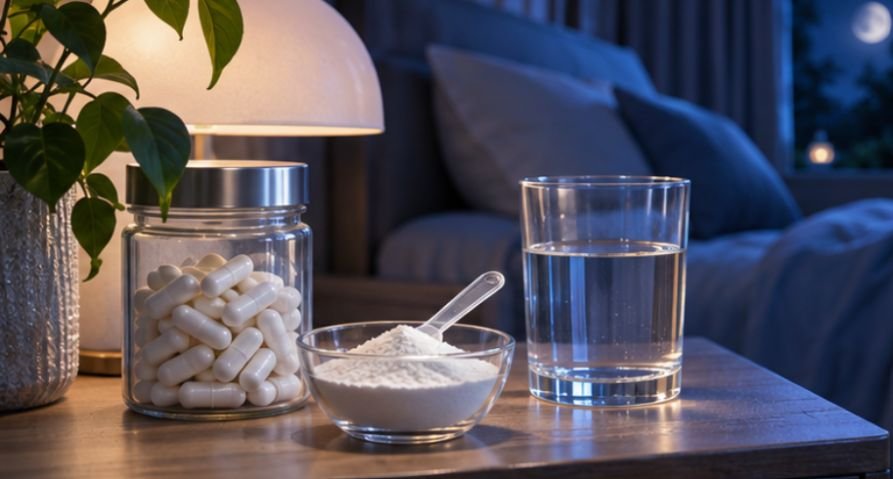
Most frequently cited human sleep trials investigated 3 grams of glycine approximately 30–60 minutes before bedtime. That amount is a research dose, not an officially established treatment recommendation.
For adults considering glycine supplementation, a practical approach involves discussing suitability with a healthcare professional before beginning.
If supplementation is appropriate, consider the following:
- Choose a single-ingredient glycine product with clearly stated serving sizes.
- Avoid combining several new sleep supplements simultaneously.
- Maintain a consistent bedtime and waking schedule.
- Monitor sleep quality, daytime alertness, and potential side effects.
- Stop supplementation and seek medical advice if unwanted symptoms develop.
Higher doses have not been demonstrated to provide proportionally better sleep benefits.
There is also insufficient evidence to establish the ideal duration of supplementation for chronic sleep difficulties.
A Simple Way to Evaluate Whether Glycine Helps
Before adding any supplement, record your normal sleeping patterns for seven nights. Estimate how long it takes to fall asleep, how frequently you wake, and how refreshed you feel the following morning.
If a clinician agrees that a glycine trial is appropriate, continue monitoring these measurements during the trial. For example, someone averaging 35 minutes to fall asleep might compare that baseline with their subsequent nightly estimates.
However, improvements could reflect changes in stress, bedtime consistency, or expectations rather than the supplement itself.
Consumer sleep trackers also cannot reliably establish precise slow-wave sleep latency. Accurate measurement generally requires polysomnography.
The most useful goal is identifying meaningful improvements in how you sleep and function, rather than chasing a particular deep-sleep percentage.
What Else Can Improve Deep Sleep Naturally?

Glycine should complement established sleep practices rather than replace them. The Centers for Disease Control and Prevention recommends that most adults obtain at least seven hours of sleep and maintain habits that support healthy rest. Several adjustments deserve attention.
Managing stress and maintaining healthy cortisol patterns can also support better sleep routines. Learn how to lower morning cortisol naturally through practical lifestyle habits that support the body’s natural daily rhythm.
Keep Your Bedroom Cool
A comfortably cool sleeping environment supports the body’s natural nighttime temperature decline.
Reduce Evening Stimulation
Dim bright lights, limit late-night screen use, and avoid demanding activities immediately before bedtime.
Watch Caffeine and Alcohol Intake
Late caffeine consumption can delay sleep, while alcohol may disrupt sleep quality despite initially causing drowsiness.
Maintain Consistent Sleep Timing
Regular sleeping and waking schedules help reinforce circadian rhythms, making it easier for the body to anticipate rest.
Establishing consistent nighttime habits can further support this process. Following a practical evening routine for circadian rhythm reset can help reinforce your body’s natural sleep-wake cycle and prepare you for restorative sleep.
These habits also provide a more reliable foundation for judging whether supplementation adds any meaningful benefit.
Safety, Side Effects, and Important Limitations
Glycine has generally been tolerated in the small, short-term sleep studies conducted so far. Nevertheless, possible side effects include nausea, abdominal discomfort, and digestive upset. Long-term safety data for routine sleep supplementation remain limited.
People who are pregnant, breastfeeding, managing kidney or liver disease, or taking prescription medications should seek individualized medical advice.
The National Center for Complementary and Integrative Health identifies cognitive behavioral therapy for insomnia as a strongly recommended treatment for chronic insomnia. Glycine is not an established substitute for that treatment.
Frequently Asked Questions
1. Does glycine increase deep sleep duration?
Research suggests glycine may shorten the time required to reach slow-wave sleep, but convincing evidence that it consistently increases total deep sleep duration is lacking.
2. How quickly does glycine work for sleep?
Small clinical studies investigated glycine taken approximately 30–60 minutes before bedtime. Individual responses vary, and a reliable time-to-effect has not been established.
3. Is glycine better than melatonin?
They have different proposed mechanisms. Glycine may influence temperature regulation, while melatonin primarily signals circadian timing. Evidence is insufficient to establish glycine as superior.
4. Can you take glycine every night?
Short-term studies have reported generally favorable tolerability, but long-term nightly use for sleep has not been adequately studied. Discuss ongoing supplementation with a healthcare professional.
Better Sleep Starts With Better Evidence
The research surrounding glycine for deep sleep latency offers an intriguing possibility: improving the body’s transition into restorative sleep without relying on conventional sedative mechanisms.
Small studies suggest benefits for sleep onset, slow-wave sleep timing, and next-day fatigue. Yet important questions remain about long-term effectiveness, individual responses, and overall clinical significance.
A supplement cannot compensate for consistently inadequate sleep, untreated sleep disorders, or irregular routines.
Start by improving your sleeping environment and daily habits. If sleep difficulties persist, seek professional guidance before experimenting with supplements.
Ultimately, better sleep is not just about reaching deep sleep faster. It is about waking up feeling genuinely restored.